RETIREMENT PLANNING RESOURCES
When Should You Claim Social Security?
Learn what changes when you claim benefits at 62, full retirement age, or 70, and what to consider before making your decision.
Getting Started with Social Security
When Can You Start Collecting Social Security?
When should you start collecting Social Security? At 62, when you first become eligible? At your full retirement age? Or should you wait until 70 to receive a larger monthly payment?
It sounds like a fairly simple question, but the answer can affect your finances for the rest of your life.
Social Security is an important source of retirement income for millions of Americans. Deciding when to claim benefits can influence how much you receive each month, how you use your retirement savings, and potentially how much income your spouse receives if you die first.
The challenge is that nobody knows exactly how long retirement will last. Someone who begins collecting Social Security at 62 could still be receiving payments 25 or 30 years later.
That is why choosing when to claim deserves more thought than simply reaching your 62nd birthday and signing up.
For most people considering their own Social Security retirement benefits, there are three important ages to understand:
Age 62 — Early Retirement
You can generally begin collecting Social Security retirement benefits at 62. However, your monthly payment will be reduced compared with what you would receive at full retirement age.
That reduction generally continues throughout retirement, although future cost-of-living adjustments may increase the dollar amount of your payments.
Full Retirement Age (66–67) — Your Full Benefit
Your full retirement age depends on when you were born. It is 66 for people born from 1943 through 1954, gradually increases for people born from 1955 through 1959, and reaches 67 for those born in 1960 or later.
At full retirement age, you can receive 100% of your calculated full retirement benefit, before applicable deductions or other adjustments.
Age 70 — Maximum Delayed Retirement Credits
Waiting beyond full retirement age increases your monthly retirement benefit through delayed retirement credits.
For someone whose full retirement age is 67, waiting until 70 increases the benefit to 124% of the amount payable at 67.
Delayed retirement credits stop accumulating at 70. There is generally no advantage in delaying your own retirement benefits beyond that age.
So, how much difference can a few years actually make? The answer may surprise you, particularly when you compare the monthly payments side by side.
Does Your Claiming Age Make a Difference?
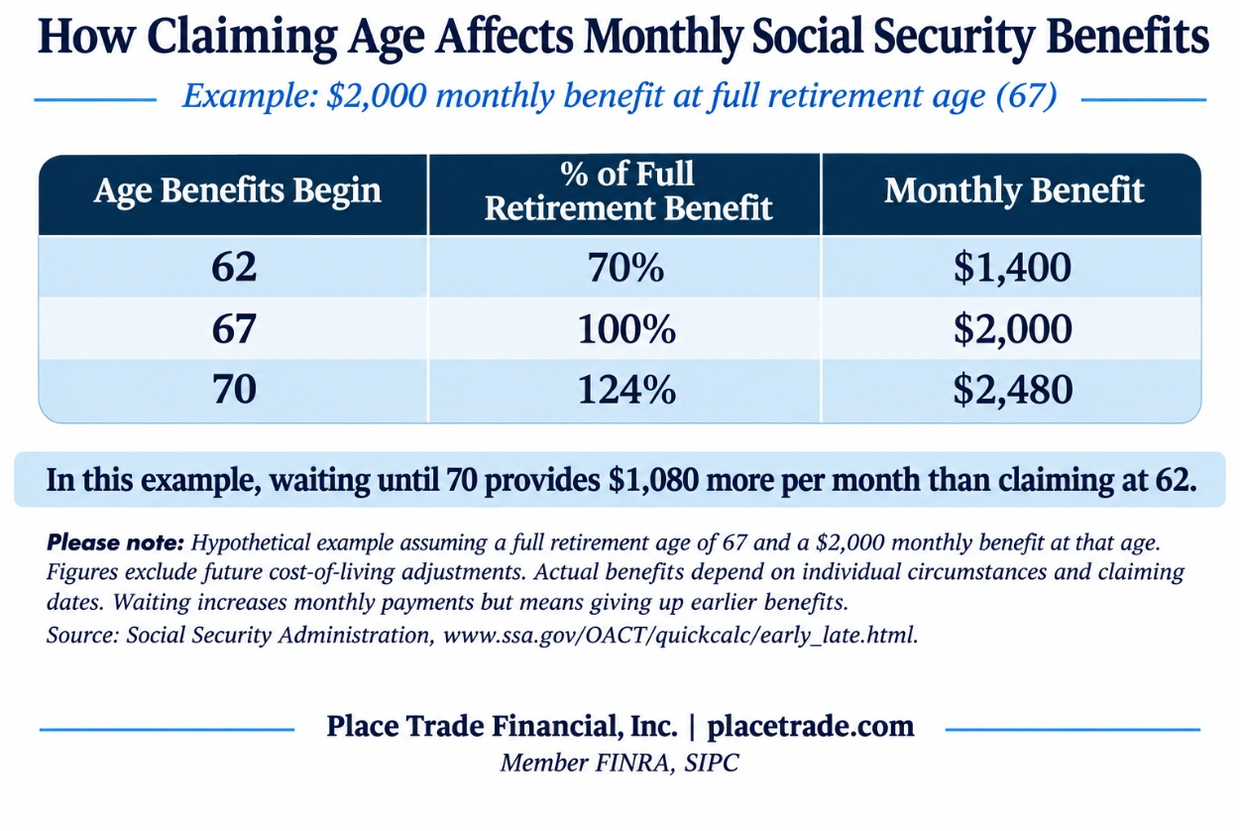
The difference can be substantial.
A Bigger Monthly Check Is Only Part of the Picture.
The age at which you begin collecting Social Security can make a substantial difference in your monthly retirement income.
For someone with a full retirement age of 67, claiming at 62 can reduce the monthly benefit by 30%, while waiting until 70 increases it by 24% compared with the full retirement benefit.
As the example illustrates, waiting can provide a larger monthly payment. However, that does not automatically mean collecting more over your lifetime. Someone who delays benefits also gives up years of earlier payments.
What is the break-even age for claiming Social Security?
How Long Until I Will Break-Even?
The break-even age helps compare the total amount of Social Security benefits someone could collect by claiming at different ages.
Using our $2,000 example, an individual who starts receiving $1,400 per month at 62 would collect approximately $134,400 by age 70, assuming 96 monthly payments and no cost-of-living adjustments.
Someone who waits until 70 would receive $2,480 per month, or $1,080 more each month.
It would take approximately 10 years and 4.4 months after age 70 for those higher payments to catch up with the $134,400 collected earlier.
Under these simplified assumptions, the break-even point occurs at approximately age 80 years and 4 months. Because Social Security benefits are paid monthly, the person who waited until 70 would first pull ahead in total payments about one month later, after receiving the 125th monthly payment.
But break-even calculations have limitations. They do not automatically account for taxes, investment returns, changes in earnings, spousal and survivor benefits, or other financial considerations.
A break-even age is a useful planning reference, not a prediction of how long someone will live or a recommendation to claim at a particular age.
Why Your Health and Life Expectancy Matter
One of the more difficult parts of retirement planning is estimating how many years your income will need to support you.
Someone facing serious health problems or immediate financial needs may have good reasons to collect Social Security earlier. For another person who is healthy, has sufficient savings, and expects a long retirement, waiting may provide valuable additional monthly income.
And remember, living a long life is generally something to hope for. The financial challenge is making sure your retirement income lasts just as long as you do.
That becomes especially important when you consider that the savings and investments someone accumulates during a working career may need to support decades of retirement expenses.
Married? Your Claiming Decision May Affect Your Spouse
Social Security planning can become more complicated for married couples, particularly when one spouse earned substantially more than the other.
Spousal benefits and survivor benefits have different rules.
A spouse may qualify for benefits based on the other spouse's work record.
However, waiting beyond full retirement age does not increase the maximum regular spousal benefit through delayed retirement credits.
Survivor benefits are different. If the higher-earning spouse delays claiming retirement benefits, the resulting higher benefit may increase the amount available to the surviving spouse, depending on the circumstances and applicable Social Security rules.
That means the claiming decision may affect more than one person's retirement income.
Couples should consider both spouses' ages, earnings histories, health, and possible survivor benefits before deciding when to claim.
Will Social Security Still Be There When You Retire?
Concerns about Social Security's future are understandable, particularly given the headlines about the program's projected funding shortfalls.
However, there is an important difference between Social Security facing a funding problem and Social Security disappearing altogether.
According to the Social Security Trustees Report released June 9, 2026, the Old-Age and Survivors Insurance Trust Fund, which pays retirement and survivor benefits, is projected to exhaust its reserves in the fourth quarter of 2032.
Without changes to current law, continuing revenue would be sufficient to pay approximately 78 cents of every dollar in scheduled retirement and survivor benefits at that time.
The report also projects that if the legally separate retirement and disability trust funds were combined, sufficient reserves would be available to pay full scheduled benefits until the third quarter of 2034. At that point, continuing revenue would cover approximately 83% of scheduled benefits.
These are projections, not enacted benefit reductions. The trust funds are separate under current law, and future legislation, economic conditions, and demographic developments could change the outlook.
Should you collect Social Security early because you are worried about future cuts?
Not necessarily.
Starting benefits earlier does not automatically protect someone from future changes. Depending on what legislation is eventually adopted, people already receiving payments could also be affected.
Claiming early out of fear could leave someone with a smaller monthly benefit for many years without guaranteeing protection against future reductions.
The funding outlook deserves attention, but it should be considered alongside your overall retirement finances rather than becoming the sole reason for your claiming decision.
Will Social Security Still Be There When You Retire?
Concerns about Social Security's future are understandable, particularly given the headlines about the program's projected funding shortfalls.
However, there is an important difference between Social Security facing a funding problem and Social Security disappearing altogether.
According to the Social Security Trustees Report released June 9, 2026, the Old-Age and Survivors Insurance Trust Fund, which pays retirement and survivor benefits, is projected to exhaust its reserves in the fourth quarter of 2032.
Without changes to current law, continuing revenue would be sufficient to pay approximately 78 cents of every dollar in scheduled retirement and survivor benefits at that time.
The report also projects that if the legally separate retirement and disability trust funds were combined, sufficient reserves would be available to pay full scheduled benefits until the third quarter of 2034. At that point, continuing revenue would cover approximately 83% of scheduled benefits.
These are projections, not enacted benefit reductions. The trust funds are separate under current law, and future legislation, economic conditions, and demographic developments could change the outlook.
Should you collect Social Security early because you are worried about future cuts?
Not necessarily.
Starting benefits earlier does not automatically protect someone from future changes. Depending on what legislation is eventually adopted, people already receiving payments could also be affected.
Claiming early out of fear could leave someone with a smaller monthly benefit for many years without guaranteeing protection against future reductions.
The funding outlook deserves attention, but it should be considered alongside your overall retirement finances rather than becoming the sole reason for your claiming decision.
What About Inflation and Rising Living Expenses?
Social Security benefits receive annual cost-of-living adjustments, commonly called COLAs. These adjustments are intended to help benefits keep pace with inflation.
However, inflation does not affect every retiree in the same way.
Healthcare, housing, insurance, and other everyday expenses may increase faster than an individual's Social Security payments. Someone who is financially comfortable at 65 could face a different financial picture at 85.
That is one reason the size of your monthly benefit matters, particularly during a long retirement.
It is also important to remember that Social Security's regular COLAs are generally applied whether or not you have already started receiving retirement benefits. Delaying does not give you access to a special inflation adjustment. Instead, delayed retirement credits can provide a higher monthly starting benefit.
What If You Continue Working?
You do not necessarily have to stop working to collect Social Security.
However, if you claim benefits before full retirement age and continue earning income from work, Social Security's retirement earnings test may temporarily reduce or withhold some benefits.
Once you reach full retirement age, that earnings limit no longer applies. The Social Security Administration also recalculates benefits at full retirement age to account for months in which benefits were withheld under the earnings test.
Continuing to work may affect your benefit calculation as well, especially if your newer earnings replace lower-earning years in your Social Security record.
If you intend to work while collecting benefits, it is worth reviewing the earnings rules before applying.
Do Not Forget About Medicare at 65
Social Security retirement benefits and Medicare are related, but they do not have to begin at the same age.
Even if you decide to wait until 70 to claim Social Security, you still need to consider Medicare enrollment when you approach age 65.
Some individuals qualify for special enrollment periods because they have eligible employer group health coverage. Others may face coverage gaps or late enrollment penalties if they miss their enrollment deadlines.
If you are still contributing to a Health Savings Account, Medicare enrollment can also have tax implications.
Do not assume that delaying Social Security means you should delay Medicare.
Questions to Ask Before Claiming Social Security
Before making your decision, consider the following:
- What would my monthly benefit be at 62, full retirement age, and 70?
- How long might I need my retirement income to last?
- Can I afford to delay benefits without putting too much pressure on my savings?
- How would my decision affect my spouse or potential survivor benefits?
- Will I continue working, and could the earnings test affect my payments?
- How might Social Security benefits and retirement account withdrawals affect my taxes?
- How would possible future benefit reductions affect my retirement plan?
- What happens to my finances if I live to 90 or 95?
Your answers may point toward different claiming strategies. The important thing is to understand the trade-offs before choosing.
Where Should You Start?
A good first step is to visit the Social Security Administration and review your personal benefit estimates through your my Social Security account.
You can compare estimated monthly benefits at different claiming ages and review your earnings record.
From there, consider how those benefits fit with your retirement savings, investment accounts, expected expenses, and other sources of income.
Social Security is only one part of retirement planning, but it is an important one. The decision you make in your early 60s may still be affecting your finances decades later.
There is no single right age for everyone to collect Social Security.
Related Retirement Planning Resources
- Products & Services
- Investment Types
- Stock Yield Enhancement
- Articles and Information
- Accessibility Policy
- Account Protection
- Anti-Fraud Notice
- BCP Disclosure
- Good Faith Violations
- Market Volatility & Risks
- Margin Disclosure
- Order Routing Practices
- Privacy Policy
- Modern Slavery
- Reg BI & Form-CRS
- Risk Warning Disclosures
- Bond Trading - Risks
- US Market Trading Hours
- Stock Trading - Risks
- FINRA Broker Check
- Support
- How to Reset Password
- CIP Notice
- About Our Founder
- Media
- Finish New Account App
Place Trade Financial, Inc.
is a member of FINRA - SIPC and registered with the MSRB. The firm is
regulated by FINRA, the US Securities and Exchange Commission, the
NFA and the Commodity Futures Trading Commission (CFTC).
Copyright © 2001-2026 Place Trade Financial, Inc. - Member FINRA, SIPC - All Rights Reserved.
This website uses cookies.
We use cookies to analyze website traffic and optimize your website experience. By accepting our use of cookies, your data will be aggregated with all other user data.